The STRADE group is presenting two papers at the IJCB 2026 conference (IEEE International Joint Conference on Biometrics), one of the leading conferences in the field of biometrics. Both deal with identity recognition using modern neural architectures, but each addresses a different modality: the first focuses on face recognition on computationally constrained devices, the second on text authorship verification.
Face Recognition for Edge Devices
Deploying high-performance face recognition models on devices with limited computational resources, such as mobile phones or security cameras, is constrained by the capacity of lightweight networks. A commonly used solution is knowledge distillation, in which knowledge is transferred from a large teacher model to a smaller student. However, standard distillation forces the student model to imitate even the teacher's unreliable outputs and does not account for the varying quality of input images.
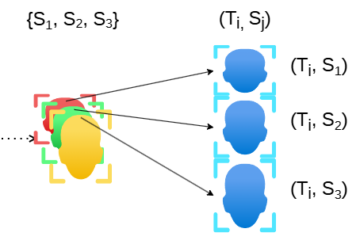
The proposed method combines the Grouped Knowledge Distillation technique with the MagFace approach, which takes sample quality into account. The first component filters out uninformative logits at the output level, while the second encodes image quality directly into the geometry of the feature space. The two components thus operate at complementary levels of the training process. The resulting student model achieves more than four times the inference throughput compared to the teacher model.
The best configuration achieved the highest accuracy on the CFP-FP dataset among the compared methods (96.24%) and comparable results on the AgeDB-30 dataset (96.78%). In addition, the student model inherits the teacher's ability to estimate image quality, assigning higher feature magnitude values to higher-quality face images.
Text Authorship Verification
Authorship verification—deciding whether two texts come from the same author—is a task in behavioral biometrics. A fundamental limitation of current systems is their implicit reliance on semantic similarity: they often mistake topical overlap for authorial overlap, and thus struggle to correctly evaluate topically different texts by the same author, or incorrectly link texts by different authors that share a common topic.
The proposed approach departs from traditional encoder-based solutions and instead uses a decoder-only architecture (Qwen3). Autoregressive pre-training of the decoder for next-token prediction leads the model to capture an author's stylistic characteristics rather than merely the content of the text. Both texts are combined into a single input, which allows the model to enable interaction between the documents through the causal attention mechanism. The model is fine-tuned exclusively using the LoRA method applied to the projection matrices of the attention layers, while the remaining weights remain frozen. The approach also includes a training-pair mining strategy focused on hard cases, which guides the model to distinguish based on style rather than topic.
The best configuration (Qwen3-4B) achieved a ROC-AUC of 0.9903 on the group's own test dataset and 0.9462 on the cross-domain PAN21 benchmark, without being trained on the data from this benchmark. Compared with the PAN21 competition systems, the proposed solution ranked above several approaches that—unlike it—had access to the benchmark's training data.
Significance
Both papers demonstrate that modern neural architectures can be effectively adapted to demanding biometric tasks. In the first case, they enable reliable face recognition directly on edge devices without a fundamental trade-off between speed and accuracy; in the second, they provide a tool for authorship verification whose importance is growing with the advance of generative artificial intelligence—for both forensic analysis and the protection of digital identity.
Tomáš Goldmann, Samuel Šimún
Magnitude-Aware Knowledge Distillation for Lightweight Face Recognition
Samuel Šimún, Tomáš Goldmann
Semantics-agnostic Authorship Verification: Disentangling Style from Content using Specialized Decoder Architecture
IJCB 2026 — IEEE International Joint Conference on Biometrics
Podpořeno FIT VUT Brno, grant FIT-S-26-9011, a projektem e-INFRA CZ (ID:90254).