Finger veins are attractive for biometric systems for one simple reason: they are hidden beneath the skin, cannot be copied from a fingerprint or photograph, and are unique to every individual. Modern recognition systems achieve excellent accuracy — but at the cost of specialised training for each new database or scanning device. Add a new user or swap the scanner, and the entire model must be retrained.
This work, driven primarily by the research of Štěpán Rydlo (FIT, Brno University of Technology), asks a different question: what if we take neural networks originally developed for matching arbitrary photographs and test whether they can distinguish finger veins — without changing a single parameter?
Method
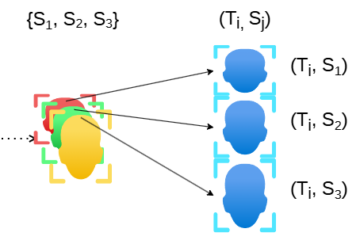
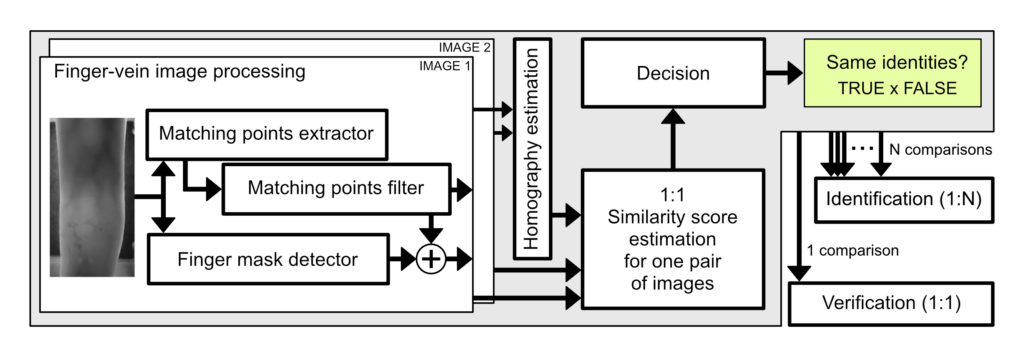
The system compares a pair of images as follows: a pretrained network finds corresponding points in both images, which are then filtered using geometric consistency (homography verification), and the resulting similarity score determines whether the two images belong to the same person. A key step is masking the finger region, which removes artefacts introduced by the scanning device. Of the five architectures tested (SuperGlue, GlueStick, ASpanFormer, LoFTR, SGM-Net), LoFTR and ASpanFormer stood out in particular — both are transformer-based and operate without explicit keypoint detection.
Results
Experiments were conducted on three public databases — SDUMLA-FV (636 fingers), MMCBNU (600 fingers), and FV-USM (492 fingers) — using identical settings across all datasets with no dataset-specific optimisation.
In the verification scenario (1:1), LoFTR with a pretrained outdoor model achieved an accuracy of 99.83% and an EER of 0.20% on the FV-USM dataset. ASpanFormer reached 99.75% accuracy and an EER of 0.28% on the same dataset. These results are comparable to specialised models trained directly on biometric data.
In the open-set identification scenario (1:N), where the system must also reject unenrolled individuals, the best result was achieved on the MMCBNU dataset with an error rate of 4.73%. Existing methods transferable across different devices typically report EERs of around 20%.
Why it matters
The system requires no biometric training data, operates independently of the scanning device, and allows new individuals to be enrolled at runtime without retraining the model — addressing a key limitation of current approaches for real-world deployment using local image features.
Štěpán Rydlo, Filip Orság, Tomáš Goldmann, Dušan Kolář Finger Vein Identification Using Pretrained Feature Matching Networks IEEE Access, vol. 14, 2026 — Open Access DOI: 10.1109/ACCESS.2026.3662722 Podpořeno FIT VUT Brno, grant FIT-S-23-8151.